Instance · Assets
Event Stream Introduction
Last updated 11 November 2026
The Event Stream is a cross-module activity logging system that provides a clear timeline of events across your Instance. It monitors admin actions, tracks record changes, and allows you to create custom events to keep track of user interactions that matter most to you.
By integrating events from your application into the timeline, the Event Stream offers a comprehensive view of activity across your Instance, capturing everything from internal system processes to external influences, form submissions, and user logins. This consolidated, searchable, filterable, and actionable stream keeps you informed at all times.
Features
- Timeline view of all events across your Instance
- Create events from any source via the Event Stream API
- Customizable colors and icons for different event types
- Searchable by description, and filterable by date period and module
- Per-entity event history (view events related to a specific record)
- Embed the event stream timeline in your project
Where to Find It
The Event Stream timeline is on the Activity tab of the Dashboard in your Instance Admin. It displays the most recent events across all modules. You can search by description, filter by date period and module, and select View on an event for full details.
Many modules also display per-entity event history. For example, a contact or company shows its events on the Event stream tab. A database item, database and opportunity show them on an Event Stream tab.
What Gets Tracked
The Event Stream automatically records actions performed by administrators across your Instance. The following modules generate event stream records:
- CRM - Contact and company create, update, and delete actions
- Pipelines - Opportunity, activity, and task actions
- Events - Event items, FAQs, sponsors, expenses, and speakers
- Permissions - Profile add, edit, and delete actions
- Ecommerce - Category, product, and order actions
- Data - Database and database item actions (add, edit, delete, duplicate, restore)
- Assets - File and folder actions (upload, edit, delete, archive, restore)
- CMS - Authorization policy actions
In addition to automatic tracking, you can create your own custom events using the Event Stream API. See Creating an Event for details.
Event Schema
Each event in the Event Stream contains the following fields. When creating events via the API, refer to your Instance API documentation at <instance URL>/admin/api for the full endpoint reference.
| Field Name | Type | Required | Description |
|---|---|---|---|
| Number | Unix epoch timestamp of the event. | ||
| String | Describes the event. Supports HTML for rich formatting and links. | ||
| String | Icon class for the event timeline item (e.g. icon-send, icon-user). | ||
| String | Color of the event timeline icon (hex value, e.g. #2a9d8f). | ||
| String | Additional detail text. Typically displays the event data as JSON. | ||
| JSON | Structured metadata containing the action type, data payload, and optionally a before snapshot for update events. | ||
| String | UUID of the entity related to this event. | ||
| String | Type of the related entity (e.g. Contact, Opportunity). |
Event Stream API Key
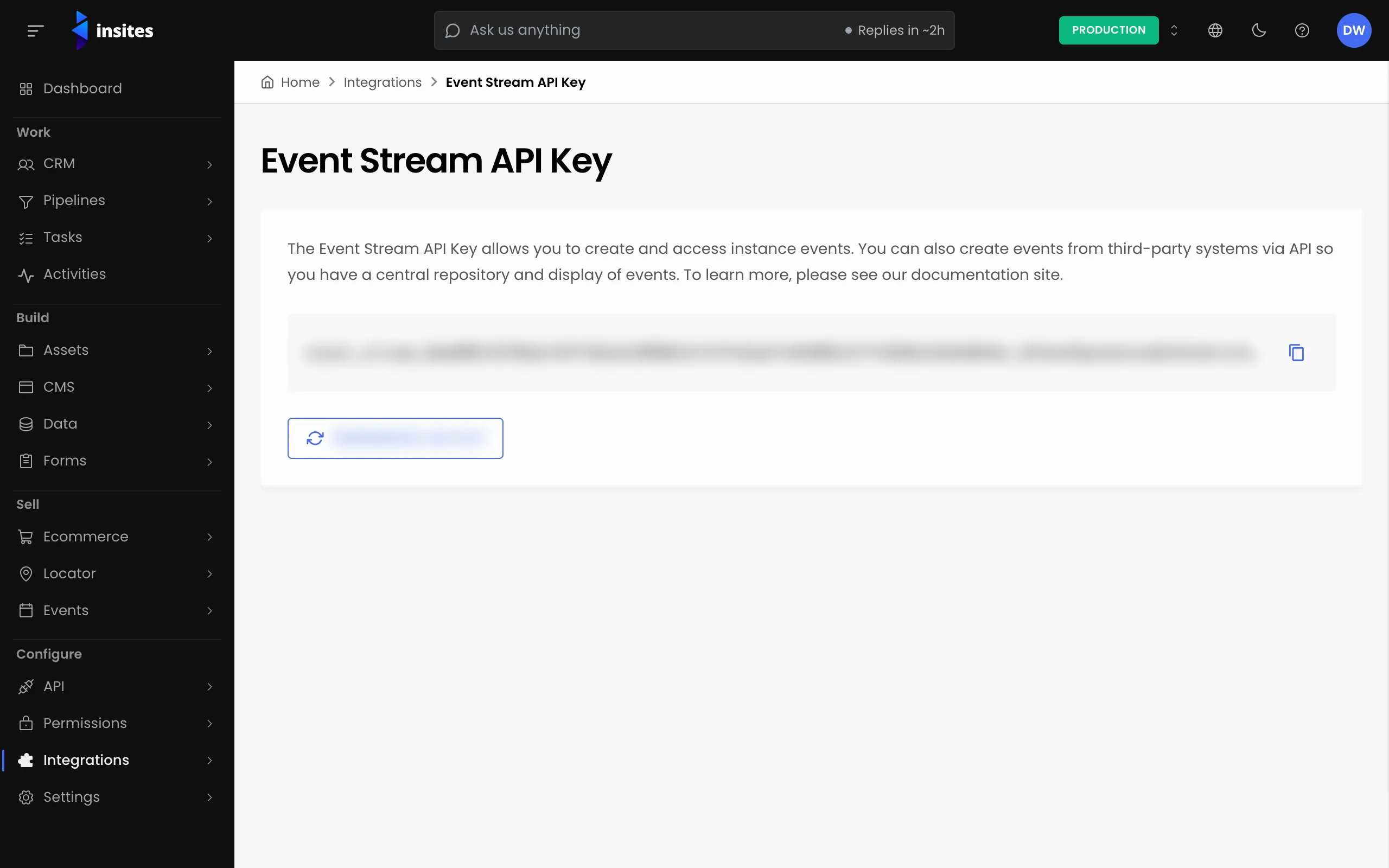
To integrate the Event Stream with external systems, you need an Event Stream API Key. This key authenticates your requests when creating or reading events via the API. See Event Stream API Key under Integrations for how to retrieve and manage your key.